?fmt=auto&qlt=default&metadata=true$poieg$&w=1000&h=1300&sm=c&poi={$this.metadata.pointOfInterest.x},{$this.metadata.pointOfInterest.y},{$this.metadata.pointOfInterest.w},{$this.metadata.pointOfInterest.h}&scaleFit=poi)
Craft, Community and Romance: A Brief History of Lace
Discover the enduring story of skill and romance a London lace maker shares the delicate, surprising world of lace making.
Read more
?fmt=auto&qlt=default)
Craft, Community and Romance: A Brief History of Lace
Discover the enduring story of skill and romance a London lace maker shares the delicate, surprising world of lace making.
This year at Liberty, our Valentine’s Day thoughts are lingering on the artistry, heritage and craft of romance. For us, lace is taking centre stage as our symbol for love: enduring, delicate and utterly unique – steeped in an artisanal history of romance. From filigree love tokens to nuptial veils hand-woven with the utmost extravagance: this fabric tells a story of love in all its artistry.
In this, we’re revelling in the thrill of date night, from the romance of an invite to the dinner table itself. Our lace-strewn thoughts come together with the help of Lauren Watson, founder of the London Lace Club, and her intricately crafted filet crochet invitation.
Here, Lauren takes us behind the scenes into a story of lace that speaks of craft, community and a continuity of artistry across generation. Love in all its intricacies captured by a history of skill, perseverance and exquisite delicacy.
How did you first become interested in lace making?
I taught myself how to crochet during lockdown, and while I was doing that, I saw a video of someone making bobbin lace online. I was totally fascinated by it. I managed to find a lace making group that was local to me, it was populated by ladies in their 70s and 80s, and they taught me how to make lace. Since then, I’ve been pursuing it by myself, which eventually led me to set up London Lace Club.
The thing that captivated me the most was the intricacy of lace making and all the unique and beautiful handmade tools that are used to create it. The most rewarding part of being a lace maker is all the people that you get to meet.
Lace making schools and lace making groups have been around since the 1600s, and that tradition has carried on until now.
As a club, we travel around the UK and also abroad, meeting other lace makers. The community aspect of bobbin lace making is really integral to the craft, and I think that’s what separates it from a lot of other textile crafts.
Lace making schools and lace making groups have been around since the 1600s, and that tradition has carried on until now. It’s an oral tradition that’s passed down through generations, mostly of women, and it’s something that’s hard to learn in isolation. I think it’s so important to make lace as part of a group, because that’s the only way it can really be passed on.
Can you tell us more about bobbin lace making?
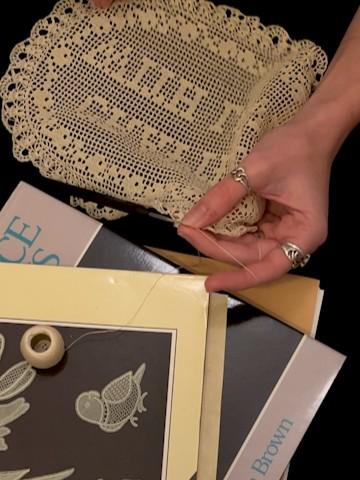
Bobbin lace making is one of the oldest forms of lace making. It’s not really known how it began, but it sprung up in lots of different areas of Europe in the 1500s. It’s made using bobbins, which were traditionally made out of bone but are now made out of wood and other materials. The lace is created by manipulating the bobbins in certain orders and rhythms, crossing and twisting them over one another, and using pins to set the lace into place.
How does the sense of history and community in lace making impact how you work?
I try to immerse myself as much as possible in the tradition of lace making, through the people that I work with and also through the work that I create. Most of the pieces I make are developed from patterns that have been given to me or ones I’ve found in old books. I focus on the more traditional aspects of lace making and try not to stray too far from the way it was done in the past.
A lot of equipment has been handmade and personalised.
The bobbins, for example, have been painted with names of husbands or children and decorated by the people who originally owned them.
As a club, we rely on donated equipment. Almost everything we use, from the patterns to the bobbins, lace making pillows and books, has been given to us by an older generation of lace makers. A lot of the equipment has been handmade and personalised. The bobbins, for example, have been painted with the names of husbands or children and decorated by the people who originally owned them.
That’s one of the most unique and special parts of lace making for me. Not only is the knowledge passed on from person to person, but also the objects, and it really makes you feel connected to one another.
You’ve created a piece for Valentine’s Day at Liberty, why do you think the fabric is associated with romance?
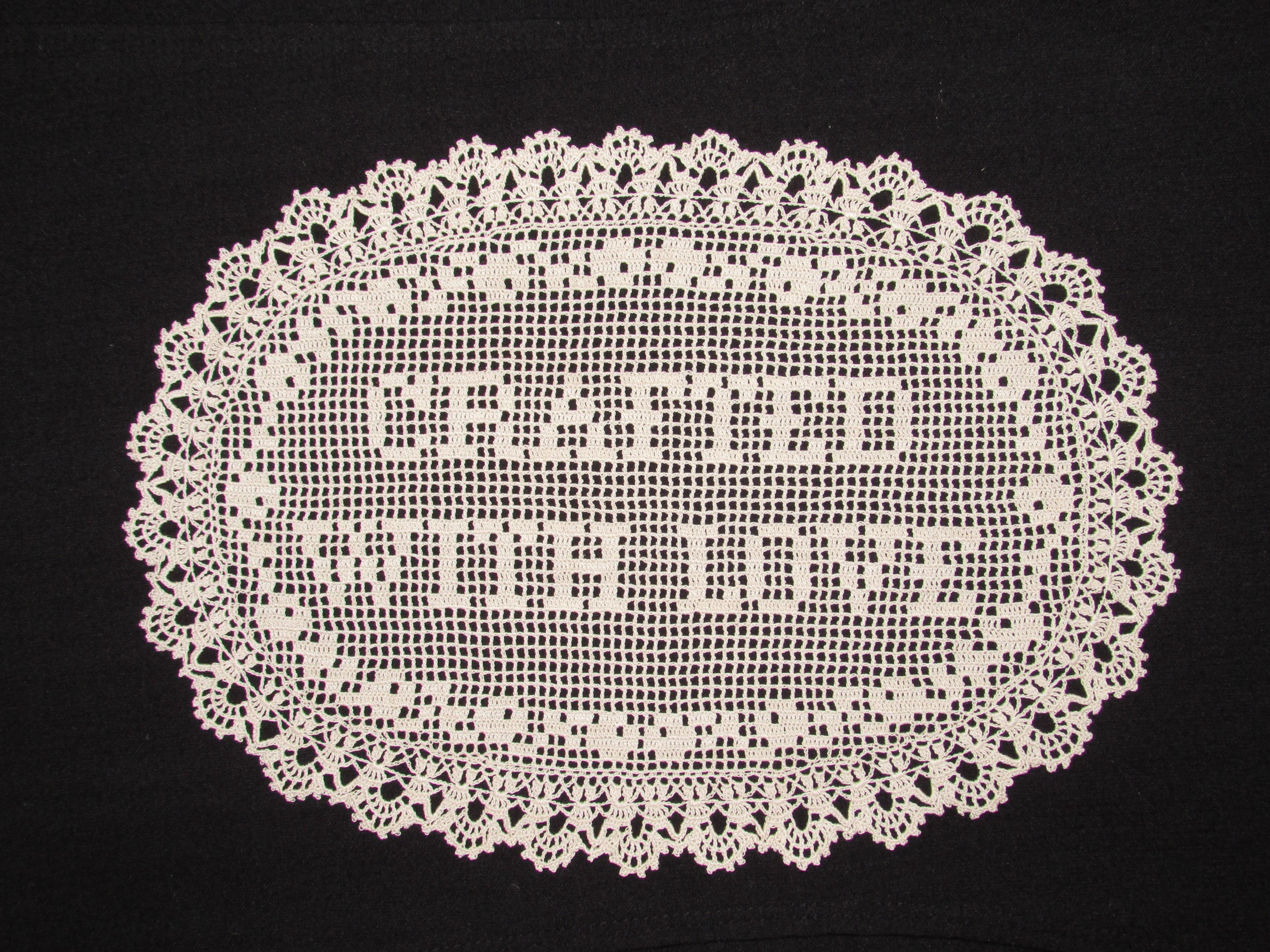
The doily I made for Liberty is made using a technique called filet crochet and filet lace. It’s designed to mimic a type of Italian lace. It uses a very tiny crochet hook, and you work on a grid. You create the grid and then fill in the squares to form a pattern, using a very small thread.
I think lace is a metaphor for revealing and concealing at the same time, which is an interesting juxtaposition and something that relates to relationships. Lace requires care, precision and delicacy, and that mirrors the care and attention needed in a relationship. The layers of lace, and the way it reveals and hides, can mimic love in that sense.
In my own practice, the process of learning and making is more important than the final outcome. I really romanticise the process itself: working with other people, being in a communal environment, and doing something that has such a long, complicated and beautiful history.
Lace making is sometimes thought of as a dying art. Why is it important to you to keep it going?
Lace making started to decline after the lace making machine was invented in the 1700s. There was a lace boom in the 1970s, when lots of lace making groups popped up around the UK, but since then many of them have slowly died out. We felt it was really important to set up a lace making club in London to help keep the craft going.
A lot of older practitioners are worried that the craft will die with them. If young people don’t start making lace, the skills won’t be passed on. You can only learn so much from books, so it’s really important to interact in real life and pass the craft on directly to one another.
We started the club in 2023, with the structure based on traditional lace making groups around the country. We have some members who are really experienced and others who are complete beginners. It’s a self-help group, so we all teach each other and answer each other’s questions, bringing different knowledge and ideas to the table. Part of the reason we set it up was so I could learn more myself.


_0824_RETOUCHED?fmt=auto&qlt=default&metadata=true$poieg$&w=1000&h=1300&sm=c&poi={$this.metadata.pointOfInterest.x},{$this.metadata.pointOfInterest.y},{$this.metadata.pointOfInterest.w},{$this.metadata.pointOfInterest.h}&scaleFit=poi)


